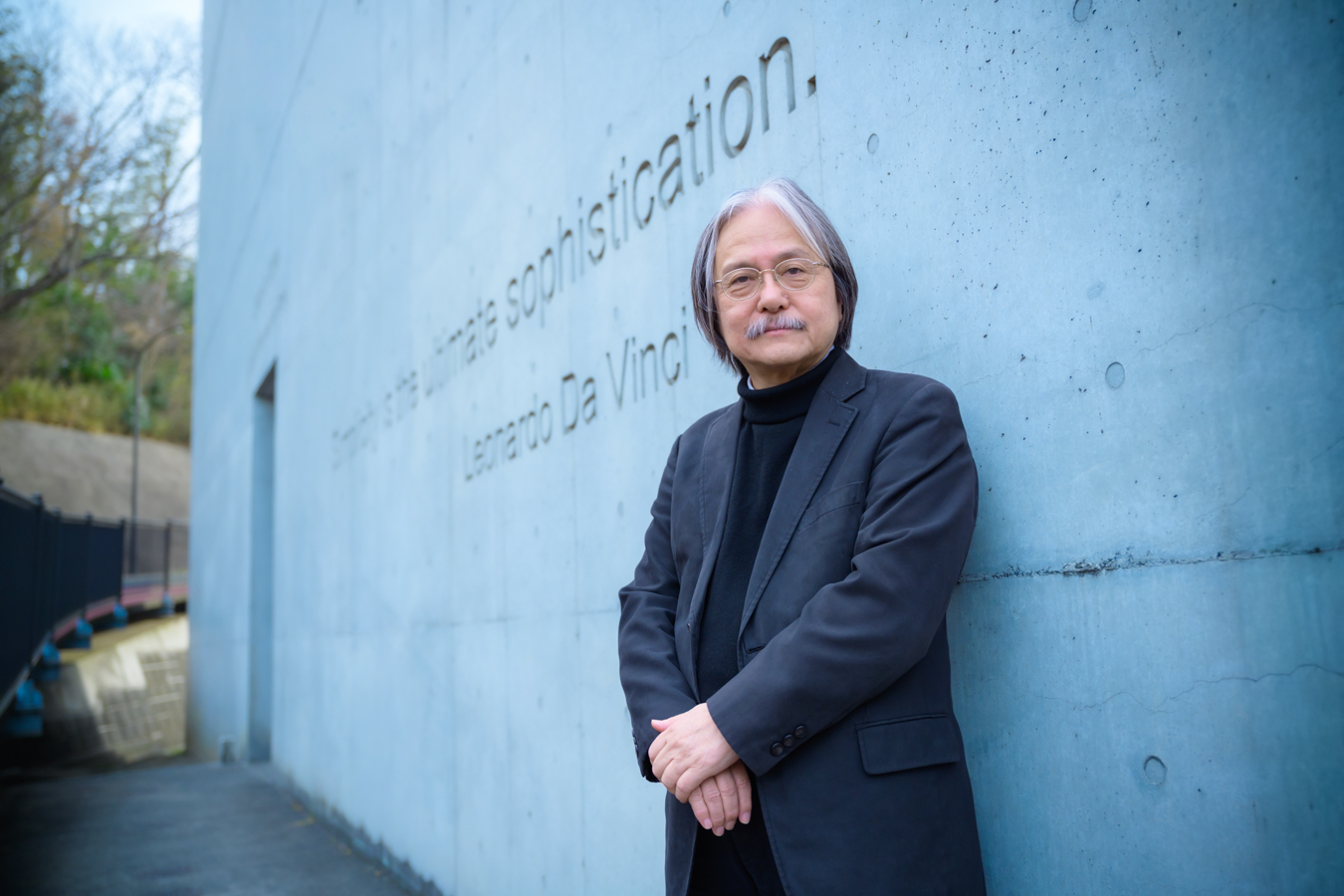
Companies are looking for new ways to connect with students.
Professor Miyake, you have long championed the need for "joint education." I understand that this joint education program has now expanded to include a new track open to working professionals. Can you start by telling us what led to this development?
About eight years ago — before this institution became Institute of Science Tokyo — we began working with companies on joint education programs aimed at addressing social issues. At the time, industry-academia collaboration was essentially limited to joint research; the concept of “joint education” didn’t exist as a term. I believed from the start that companies should be involved in education alongside universities, so I coined the phrase “joint education” myself.
The model offers significant benefits for companies. Getting involved in talent development before students even join the workforce is a form of social contribution, and the connections formed with students on the ground also give companies an advantage in recruiting. In the early days, I went around to tech companies — Google, Yahoo, teamLab — and made the case for this approach. Those efforts gradually paid off, with more and more companies expressing interest and lending their support, and the joint education framework at Institute of Science Tokyo took shape. Today, the program counts 46 partner companies spanning finance, materials, information and communications, manufacturing, pharmaceuticals, trading, energy, transportation, construction, real estate, housing, and more.
Students learn theory in the classroom, but they have little exposure to what it actually looks like to solve problems in the real world. That’s why, up until now, the arrangement has been for professionals from our partner companies to come to campus and teach. In recent years, however, companies have also started to feel the pressure to develop DS&AI talent internally. When joint education first launched, qualified DS&AI instructors were scarce even within universities — but universities have since built up that capacity.
So we launched this new joint education program as a way for the university side to support companies in their internal training efforts. The term “reskilling” — updating professional skills to stay current — has become a buzzword, but what we have in mind is closer to “recurrent education”: a commitment to continuous, lifelong learning. The spirit of this program is not just to benefit from our partner companies, but for the university to give back — to support a culture of ongoing learning.
Bringing Institute of Science Tokyo course content directly to an on-demand platform
What does the new program actually consist of?
It has two components: “DS&AI On-Demand Courses,” which deliver our university’s DS&AI lectures in an on-demand format, and “DS&AI Co-Creation Group Work,” in which working professionals and students exchange ideas on problem-solving through group work sessions.
Starting with the on-demand courses: Institute of Science Tokyo has already produced teaching materials covering every DS&AI course offered, from undergraduate through doctoral level. This year, we opened up the first- and second-year undergraduate courses to partner companies. In preparing for the launch, we worked through issues such as copyright clearance and reshot portions of the content where needed. Each class session runs 100 minutes, with seven sessions per course — 700 minutes in total. We opened three courses, giving a combined total of 2,100 minutes of content. That’s already a substantial amount on its own. Currently, 23 partner companies that expressed interest have been given access keys and are using the platform
Is access limited to partner companies?
For now, yes. Even though the format is on-demand, we aim to make it as interactive as possible and do accept questions, so we’ve limited access to partner companies in order to manage capacity and maintain quality.
University courses teach a subject systematically, covering the full curriculum. When you’re working in industry, it’s easy to go deep only in your own specialty, but taking these courses helps you recognize your own gaps and develop a broader perspective. That’s one of the real strengths of a university education. The other is that participants are taking the same courses as Institute of Science Tokyo students. That shared experience, I think, can be a powerful motivator.
Real workplace challenges discussed by mixed teams of company employees, students, and faculty.
What actually happens in the "Co-Creation Group Work" sessions?
Participants develop the ability to conceptualize solutions to social issues. Group work between companies and students isn’t unusual — other universities do it too — but in most cases companies provide practice problems for the purpose of educating students. In our “Co-Creation Group Work,” by contrast, companies bring genuinely pressing, real problems they are actively grappling with. Along with company employees and students — including graduate students — faculty from our university also participate, contributing expert perspectives from academia.
Everyone sits down together to discuss the actual challenges each company is facing in the field. That’s precisely why students find it engaging, and why they also get a feel for the culture of each company. For the companies, it’s a chance to encounter fresh ideas from outsiders with no stake in their industry — and they may well walk away with a new lead or two. After the discussions, there’s also a presentation session. We’re proud to say this kind of format is unique to Institute of Science Tokyo.
Can you give us a sense of the kinds of concrete challenges companies bring to the table?
One company, for example, handles maintenance as well as sales for its own products. At the repair facility, when they’re disassembling multiple units laid out on a workbench, how should they assign tasks among the technicians? What would it take to cut maintenance time and man-hours? They’re working on optimization problems like that on the shop floor. These are genuinely real-world problems with direct cost implications.
Of course, the companies don’t expect students to solve them completely in a few months of group work — but the first step is simply sharing what the actual problem looks like. There’s always a chance that a new methodology or angle will emerge. And for the faculty involved, these sessions can become the seeds of future joint research with those companies. The group work setting is a kind of open field where companies and the university can freely step into each other’s worlds.
Many of the participants sent by companies are junior employees, and you can feel their genuine hope that students and young people will bring creative, unexpected ideas. From the university’s perspective, sending the message through initiatives like this that “Institute of Science Tokyo takes social issues seriously” is something we believe will draw an even broader wave of engagement going forward.
How have the students responded?
Once you’re in a group work session, you can’t just sit there passively. One team, for instance, was given an optimization problem as homework by the company, and came back the next session having worked through it and ready to present their findings. I think it’s precisely because the companies are so serious that the students feel compelled to give the challenges their all.
DS&AI, which is the discipline of "ways of seeing," forms the foundation of research capacity.
How does this new program fit within the broader mission of the Center for DS&AI Education?
Our initial mission — to develop DS&AI talent within the university — has found its footing, and I see the next role of this organization as expanding outward: extending what we do beyond the campus and into society at large. At a time when AI is reshaping industry structures, DS&AI is no longer just a concern for universities — it’s a new set of skills that everyone needs. We have, in a very real sense, entered the age of reskilling
Institute of Science Tokyo has been designated a "University for International Research Excellence" by the Ministry of Education, Culture, Sports, Science and Technology (MEXT), and will receive substantial funding for up to 25 years. Does this new program connect to that initiative?
With this designation as a starting point, our university president, Naoto Ohtake, introduced a framework called the “Visionary Initiatives (VIs)” — a shift away from siloed, discipline-specific research toward a cross-disciplinary approach. The goal is for researchers across the entire university to progressively join one of the VIs, accelerating integrated research. That’s because solving the complex societal issues we face requires collaboration that cuts across disciplinary boundaries.
And the VI concept turns out to be a natural fit with DS&AI. DS&AI is a discipline that every field needs — one that can weave through all domains; it is, in a sense, a “discipline of ways of seeing.” The very reason the Center for DS&AI Education was created was to run a horizontal thread through what had been a vertically siloed university curriculum.
If that’s the case, DS&AI becomes essential to every VI — and the direction this organization should be heading is clear. We aim to be the broadest horizontal thread, developing talent that can contribute to each individual VI. That, ultimately, is what forms the foundation of research capacity. In that sense, the need for what this organization does is only growing, and we are committed to meeting that need.
Off-the-Record Chat
I don't usually make grand pronouncements, but let me say just this: I think we're moving toward an era in which the distinction between "student" and "working professional" will lose its meaning. In other words, the boundary between students and professionals will become increasingly blurred. Students can no longer afford to stay inside the university simply absorbing theory — their connection to society, their hands-on practice, and their real-world experience are becoming critically important. That's precisely why we've introduced "internship courses" at our university.
At the same time, those already in the workforce will find their opportunities shrinking if they don't keep learning new skills and theories in emerging fields. A society in which students and professionals alike learn from one another without borders — that is the ultimate goal of joint education. So to students and young professionals, I want to say: make the effort to constantly reinvent yourself through learning. Learning is genuinely exciting. There's even a saying that goes, "the last thing people become obsessed with, after they've exhausted every other pleasure life has to offer, is research" (laughs).